


Creative Day Out in Bristol: Galleries, Street Art and Sketching Spots
A walkable day of galleries, harbour cranes and street art in Bristol, with sketching spots, writing prompts and a practical route for artists and writers.
Creative Day Out in Bristol: Galleries, Street Art and Sketching Spots
Bristol is small enough to walk and dense enough to keep you interested. In one day you can look at contemporary art in a converted tea warehouse, pass a mural painted by someone visiting from São Paulo, and end up on a hill with the city laid out below you. This route is for artists and writers who would rather look properly than tick off a list. Take a small sketchbook, a pencil and something waterproof to sit on.
Begin at the water: Arnolfini and M Shed
Start on Narrow Quay at Arnolfini. The galleries are free, the building is a nineteenth-century tea warehouse, and the upper floors have windows that frame the floating harbour like a viewfinder. Arrive when the doors open. The rooms are almost empty then, and you can stand in front of one piece for ten minutes without stepping around anybody. If the current show is video or sound, sit on the floor if allowed; the longer you stay, the more the piece gives you. Look at the way the light changes on the water outside, too. That is part of the exhibition on a clear day.
Two minutes along the quay is M Shed, also free, where Bristol tells its own story through objects, film and recorded voices. The labels and the audio are as useful to writers as the exhibits are to artists: people describing their working lives in their own words, with all the odd detail left in. Look for the harbour stories, the old signs, the photographs of boats and cranes. Copy down three phrases that sound like speech, not writing. You will use them later.
One note before you plan anything: many Bristol galleries close on Mondays and Tuesdays and go dark between exhibitions. Check opening times the day before, and keep a harbourside walk as your fallback. The water, the bridges and the cranes do not close.
Sketching at Underfall Yard
Walk west past the ss Great Britain and keep going to Underfall Yard, the Victorian harbour workshops on the far side of the dock. Slipways, cranes, sluice gates, boats propped up on props. Everything is square, layered and slightly rusted, which makes perspective unusually easy to read. Go in the morning and you get light coming off the water; by late afternoon the cranes flatten into silhouettes, which is a different drawing altogether. There are benches and low walls, but the best spot is often the edge of the dock itself if it is dry. Draw the same crane twice: once as a set of boxes, once as a set of lines. The second drawing will teach you more.
Cross the water to Spike Island and Bedminster
Spike Island, on Cumberland Road, is a gallery and a studio building in one. The exhibitions are free and often feel close to the making — you can see how a piece was put together, not just how it was hung. From there, walk south into Bedminster and follow North Street. Upfest, the street art festival that has run in the area for years, has left murals on gables, shutters and the sides of corner shops. The area changes constantly, so do not chase a map of specific pieces. Walk with your eyes up and your sketchbook open.
Here is a rule worth keeping: draw the small ones. A three-storey mural resists a sketchbook, but a painted shutter with a wheelie bin in front of it gives you scale, texture and a bit of human mess. Look for the pieces that sit next to real life: a bright parrot beside a fire escape, a portrait above a takeaway sign, a pattern that runs behind a parked van. Those are the drawings that will look like Bristol later, not like a festival programme.
If a mural is too big, draw the corner of it. If a street is too busy, draw the shadow it casts on the pavement. You are not making a record. You are making a way of seeing.
Stokes Croft and the centre: paint, posters, politics
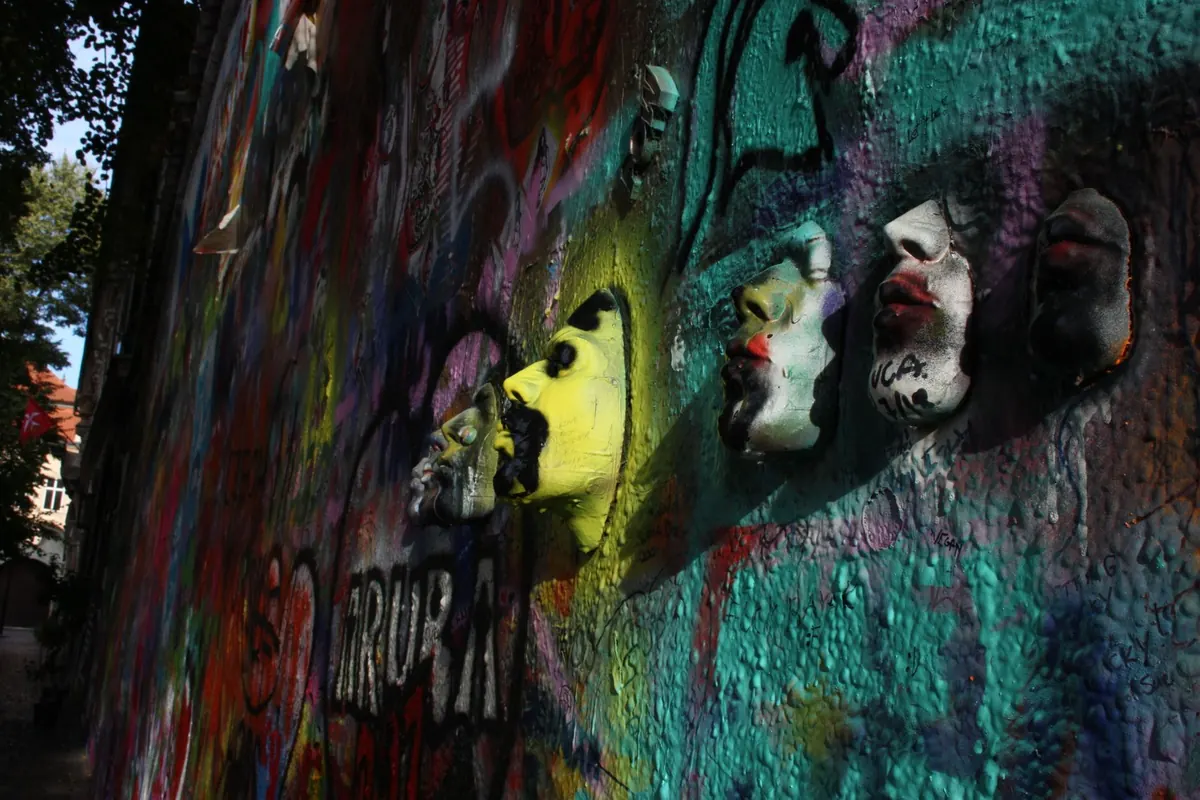
Head north to Stokes Croft, where the walls carry slogans, portraits and years of overlapping paint. Jamaica Street, the Bearpit roundabout and the buildings around Hamilton House are worth a slow circuit; the People's Republic of Stokes Croft has shaped the area's visual character for a long time. This is not a tidy open-air gallery. It is a working neighbourhood with traffic, bins, scaffolding and people going about their day. Sketch quickly and keep your bag close. The best drawings here are often made in ten minutes while you stand at a bus stop.
Then drop into the centre. There are large murals on Nelson Street, small free shows at Centrespace Gallery on Leonard Lane, and the steep, layered view down Christmas Steps. On Queen's Road, Bristol Museum & Art Gallery is free and holds both fine art and natural history, which makes it a solid wet-weather substitute. If your energy is fading, the museum is the place to sit on a bench and draw a stuffed bear or a Roman coin. Nobody will mind.
Six places to sit down and sketch
- Cabot Tower, Brandon Hill. Climb for the panorama, then come back down and draw the tower from the grass. Benches, trees and a clear skyline make this the best place to start or finish. The tower itself is a lesson in vertical perspective: look up, then look down, then draw the shape between.
- The upper floor of Arnolfini. The windows turn the harbour into moving pictures. Sit by the glass and draw the boats, bridges and cranes as simple blocks. When someone walks past, include them for scale.
- Underfall Yard. Slipways, cranes and water. Choose a corner with three layers: foreground rope, middle boat, background shed. Draw the layers, not the details.
- M Shed benches. Sit outside by the water or inside near the exhibits. The old photographs are good prompts: draw the scene as it is now, then draw what might have been there a hundred years ago.
- Christmas Steps. A steep, narrow street with signs, windows and people moving up and down. Sketch from the bottom looking up, then from the top looking down. The same place becomes two different drawings.
- Stokes Croft pavement. Find a wall with a poster, a painted shutter or a piece of graffiti that is half-peeling. Sit on a step or lean against a railing. Draw fast. If you have five minutes, draw only the shapes and the letters.
Practical notes for a sketching day
Bristol weather changes quickly, so treat the day as a series of short stops rather than one long outing. A small A5 sketchbook, a pencil, a fine liner and a water brush are enough. If you use ink, take a waterbrush or a small water pot; if you use pencil, take a soft eraser and a putty rubber. A lightweight folding stool or a piece of foam to sit on will make more difference than another pen.
- Best light: morning for the harbour and Underfall Yard, early afternoon for North Street and Bedminster, late afternoon for Stokes Croft and Christmas Steps.
- Best days: Wednesday to Sunday for galleries. Monday and Tuesday are for street art and waterfront walks.
- Free toilets and rest stops: M Shed, Arnolfini, Bristol Museum & Art Gallery, and most large cafes on North Street and Stokes Croft if you buy a coffee.
- What to carry: a pencil case, a waterproof layer, a bottle of water, and a plastic bag to sit on. Do not carry a heavy easel. You will not use it.
If you have time: two short extensions
For writers: the harbourside at low tide
Come back to the water when the tide is out. The harbour shows its muddy edges, old chains, tyres and broken bits of boat. Writers will find better material here than in any gift shop: overheard conversations, names on buoys, the smell of the mud. Sit on a bollard and write for fifteen minutes without stopping. Do not edit. The point is to catch the place before it tidies itself up in your memory.
For artists: a second pass at the same view
If you have an hour left, return to one place you drew earlier and draw it again from a different angle. Draw Cabot Tower from the bottom of Brandon Hill, then from the top of Park Street. Draw the same crane at Underfall Yard in the morning and in the late afternoon. The second drawing is almost always better, because you have stopped trying to be accurate and started trying to be awake.
Bristol rewards that kind of attention. It is a city that wears its layers openly: tea warehouse, dockyard, street art, museum, hill. One day is not enough to see it all, but it is enough to fill a small sketchbook, and that is the point.
Photo: Joshua Köller / Pexels